Dongguan Hetair Intelligent Equipment Co., Ltd.
Search

How Paint Agitators Improve Paint Stability in Industrial Coating Preparation and Mixing Systems

Why Paint Stability Is Critical Before Industrial Spraying

In industrial coating workflows, paint stability is not determined at the spraying stage, but much earlier—during the pre-spray preparation stage. This stage defines whether the coating will behave consistently once it enters the application system. Paint is a multi-phase material composed of pigments, resins, solvents, and additives. Over time, these components naturally tend to separate due to density differences. If this instability is not corrected before spraying, the downstream process becomes unpredictable.

Key stability challenges include:

  • preparation stage importance in determining final coating quality

  • unstable paint affecting downstream spraying performance

  • viscosity variation during production and storage cycles

  • pigment separation before transfer into spray or circulation systems

In real production environments, even small inconsistencies in preparation can lead to significant coating variation, especially in high-precision industries such as automotive and electronics manufacturing.


Common Problems in Paint Preparation Systems

Before coating materials enter spraying or circulation systems, they pass through a preparation stage where inconsistencies are most likely to occur. This stage is often underestimated but plays a critical role in production stability.

Typical issues include:

  • inconsistent batch mixing between production cycles

  • sediment formation during storage in paint containers

  • uneven pigment dispersion within coating formulations

  • unstable viscosity before transfer to spray equipment

  • manual mixing inefficiency that fails to maintain uniformity over time

These issues are particularly common in pre-coating preparation environments, where coatings are stored in containers and used intermittently. Without continuous agitation, gravitational separation gradually affects material uniformity, leading to inconsistent coating behavior.


How Paint Agitators Improve Paint Homogenization in Mixing Tanks

A paint agitator is designed to maintain continuous internal motion within coating containers, ensuring that pigments and binders remain evenly distributed throughout the entire volume.

A standard definition:

A paint agitator is an industrial mixing device that maintains continuous circulation of coating materials inside a container to ensure uniform pigment distribution, stable viscosity, and prevention of sedimentation during storage and preparation.

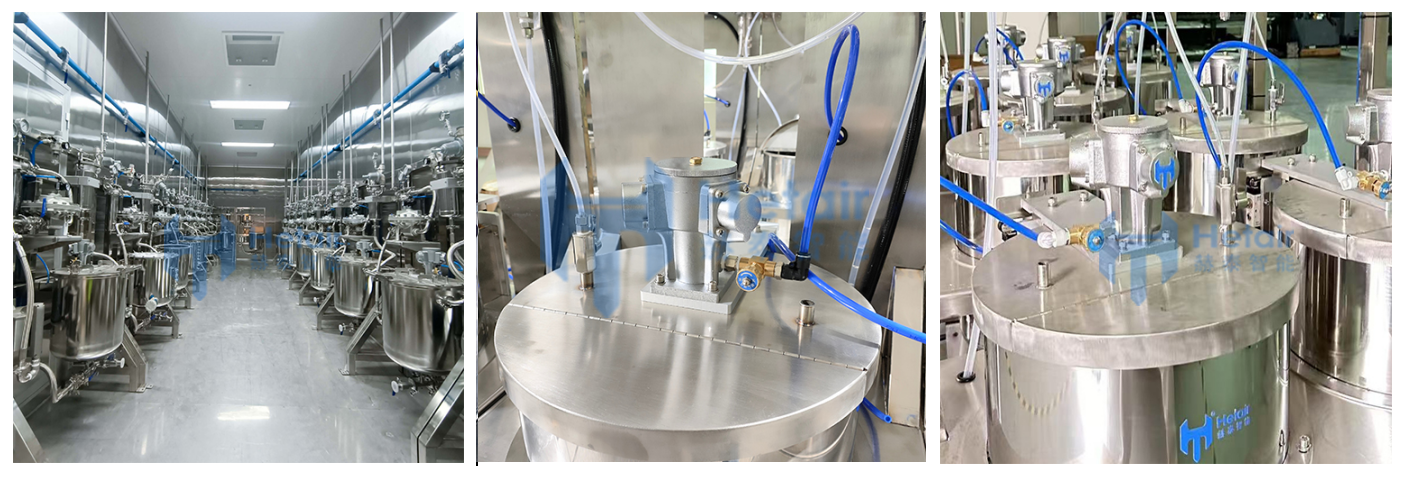
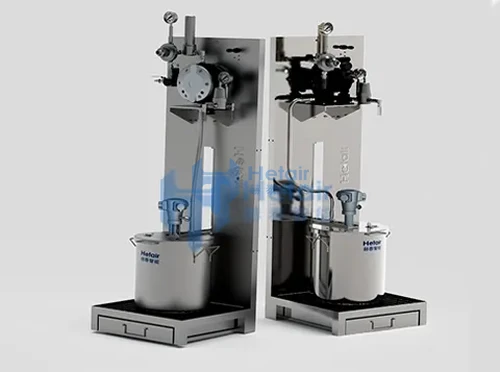
In industrial systems, the hetair paint agitator, including the 5 Gallon Paint Agitator/Paint Mixer, is widely used to stabilize coating preparation before spraying.

Its core functions include:

  • continuous container-level mixing for uniform material distribution

  • stabilization of pigment dispersion across the entire paint volume

  • elimination of stratification caused by gravity separation

  • maintaining viscosity stability during storage and transfer

  • improving batch-to-batch consistency in production environments

Unlike manual stirring, which provides only temporary homogenization, mechanical agitation ensures continuous stability throughout the entire preparation cycle.

5-gallon-agitator-wholesale-supplier.png

Why Pneumatic Agitation Improves Industrial Safety and Efficiency

In industrial coating environments, safety is as important as performance. Many coatings contain flammable solvents, making electrical equipment unsuitable in certain zones. Pneumatic agitation systems provide a safer and more stable alternative due to their operating principles.

Key advantages include:

  • explosion-safe pneumatic drive suitable for hazardous environments

  • stable speed control for different coating viscosities

  • reduced operator intervention during continuous production

  • suitability for paint shop environments with strict safety requirements

The pneumatic design also ensures consistent torque output, which is essential when mixing high-viscosity or high-solid coatings.


Role of Three-Dimensional Mixing in Paint Preparation Systems

One of the most important engineering features of modern agitators is three-dimensional mixing behavior. Instead of simple rotational motion, the system generates multi-directional flow inside the container. This improves mixing efficiency significantly.

Key effects include:

  • propeller-driven circulation inside the paint container

  • multidirectional mixing flow eliminating dead zones

  • improved homogenization efficiency across full volume

  • reduced sediment formation during storage periods

This type of mixing is especially important for coatings containing heavy pigments or metallic particles, which tend to settle quickly under static conditions.


How Paint Agitation Improves Downstream Spray Quality

Although paint agitators operate in the preparation stage, their influence extends directly into spraying performance. Stable pre-mixed coatings ensure more predictable downstream behavior.

However, this section focuses on indirect effects rather than spray system mechanics:

  • better spray atomization consistency due to uniform viscosity

  • improved coating uniformity across applied surfaces

  • reduced nozzle clogging caused by particle aggregation

  • stable downstream performance during continuous operation

In industrial production, stable preparation is often the difference between consistent output and frequent rework cycles.


5-Gallon vs 15-Gallon Paint Agitator Selection Guide

Different production scales require different container capacities and mixing dynamics.

Parameter5 Gallon15 Gallon
ApplicationSmall batch preparationLarge batch preparation
Speed Range0–1200 RPM0–900 RPM
Shaft SizeΦ12 × 350 mmΦ14 × 450 mm
Use ScenarioFrequent color change operationsContinuous production environments

The 5-gallon system is typically used in flexible production setups where quick changeovers are required, while the 15-gallon system is better suited for stable, high-volume coating preparation.


Applications in Paint Preparation and Coating Industries

Paint agitators are widely used across multiple industrial sectors where coating stability is essential for quality control.

Typical applications include:

  • automotive refinishing requiring precise color consistency

  • furniture manufacturing with decorative coating requirements

  • industrial equipment coating for corrosion protection

  • electronic surface treatment requiring uniform film formation

In all these applications, consistent paint preparation directly impacts product durability and surface quality.


Conclusion

Paint agitators play a fundamental role in ensuring coating stability during the preparation stage. By maintaining uniform mixing, preventing sedimentation, and stabilizing viscosity, they improve both production efficiency and final coating quality across a wide range of industrial applications.


FAQ

Why is paint mixing important before spraying?

Because it ensures uniform pigment distribution and stable viscosity, which directly affects coating consistency.


How does a paint agitator improve paint stability?

It continuously mixes the coating inside the container to prevent sedimentation and phase separation.


What is the role of pneumatic paint agitators?

They provide safe and stable mixing in environments where flammable coatings are used.


Can agitators handle solvent-based and water-based paints?

Yes, they are designed to support a wide range of coating viscosities and formulations.


What is the difference between 5-gallon and 15-gallon agitators?

5-gallon models are used for small batch flexibility, while 15-gallon models support larger-scale production stability.


References 


Explore More Hetair Automatic Paint System and Robot Products


Latest News about Hetair
ht@hetaircn.com
+86-0769-85395351
We use cookies on this site, including third party cookies, to delivery experiennce for you.
Accept Cookies
Read Privacy Policy