Dongguan Hetair Intelligent Equipment Co., Ltd.
Search

Why Paint Agitators Are Essential for Preventing Paint Settling and Ensuring Coating Consistency

Why Paint Settling Occurs in Industrial Coating Processes

Paint settling is a natural physical phenomenon in liquid coatings, especially when pigments and fillers have higher density than the base resin. In industrial environments, this issue becomes more obvious due to batch preparation and intermittent usage patterns.

In typical production workflows, coatings are often stored in containers before use. During this period, gravity causes solid components to gradually move downward, while lighter components remain in the upper layer. This leads to an unstable mixture that cannot deliver consistent performance during spraying.

Common causes include:

  • pigment sedimentation in paint drums

  • metallic particle separation caused by density differences

  • viscosity imbalance during storage due to temperature variation

  • inconsistent paint preparation before spraying in manual operations

  • manual stirring inefficiency that cannot maintain long-term suspension

This issue is especially common in 5-gallon paint container environments, where paint is frequently used in small batches. Since these containers are often opened and reused multiple times, the coating material is repeatedly exposed to air and static conditions. Without continuous movement, even well-formulated coatings will gradually lose homogeneity.


How Improper Mixing Leads to Color and Coating Defects

When paint is not properly homogenized before application, the instability is directly reflected in the final coating layer. Unlike simple color differences, the impact extends into structural coating performance.

For example, when pigment distribution is uneven, one batch may contain higher pigment concentration than another. This creates visible inconsistencies during spraying, especially under controlled lighting conditions used in automotive and industrial inspection processes.

Typical defects include:

  • color mismatch between production batches due to uneven pigment distribution

  • uneven film thickness caused by inconsistent viscosity during spraying

  • poor surface finish quality such as streaking or mottling

  • increased rework and material waste due to rejected coating parts

  • unstable coating performance during spraying under continuous operation

In industrial coating engineering, one principle is widely accepted: final coating quality is determined long before spraying begins. The preparation stage, especially mixing, is a critical control point that directly influences transfer efficiency and film formation stability.


What Is a Paint Agitator and How It Works

A paint agitator is an industrial mixing device designed to maintain continuous movement of coating materials inside a container, ensuring uniform pigment distribution and stable viscosity throughout the storage and application process. In engineering terms, it functions as a controlled fluid agitation system that prevents phase separation and maintains material homogeneity over time.

A paint agitator is defined as:

A mechanical device used in coating systems to continuously mix liquid paint, ensuring uniform particle suspension, stable viscosity, and prevention of sedimentation during storage and preparation.

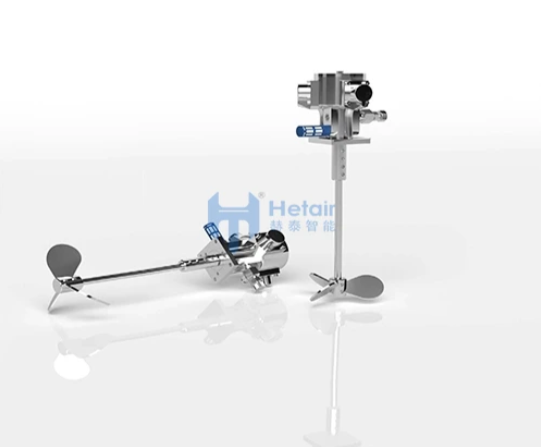
The 5 Gallon Paint Agitator/Paint Mixer from hetair is designed specifically for container-level mixing applications. It is widely used in pre-spray preparation stages to ensure that coatings remain consistent before being transferred to spray systems.

Its working principle includes:

  • continuous mechanical mixing inside paint containers

  • uniform pigment distribution through controlled agitation flow

  • viscosity stabilization before spraying operations

  • anti-sedimentation mechanism that prevents particle settling over time

Unlike manual stirring, which only provides temporary mixing, a paint agitator maintains continuous energy input into the fluid, ensuring long-term stability of the coating material.

Paint Agitator.png

How a Paint Agitator Prevents Paint Settling in 5-Gallon Containers

In small container systems, paint settling occurs faster due to limited fluid volume and reduced natural circulation. A paint agitator solves this by introducing continuous motion inside the container, eliminating static zones where sedimentation typically begins.

The mechanism works through several physical processes: Continuous agitation creates a controlled internal flow field inside the drum. This prevents heavier particles from accumulating at the bottom. At the same time, the motion generates vertical circulation loops that keep pigments suspended throughout the liquid volume.

Key mechanisms include:

  • continuous agitation inside drum creating constant fluid movement

  • three-dimensional fluid movement that circulates material in multiple directions

  • elimination of stagnant zones where sedimentation typically begins

  • maintaining pigment suspension stability throughout storage and usage cycles

  • reducing manual remixing frequency required before spraying

This is particularly important in production environments where paint may remain in containers for extended periods between uses. Without agitation, the lower layer of the paint becomes significantly more concentrated, leading to inconsistent spray output.


Benefits of Using a 5-Gallon Pneumatic Paint Agitator

The pneumatic design of industrial paint agitators is widely adopted in coating environments due to its safety and operational stability. Unlike electric systems, pneumatic drives reduce ignition risks in flammable coating environments.

Key performance characteristics include:

  • pneumatic drive safety suitable for explosion-risk paint shop environments

  • stable working pressure range of 0.3–0.7 MPa ensuring consistent torque output

  • stepless speed adjustment from 0 to 1200 RPM for different coating viscosities

  • compatibility with both water-based and solvent-based coatings

This flexibility allows operators to adjust mixing intensity based on coating type. Lower viscosity coatings require gentle agitation, while high-viscosity materials require stronger mixing force to maintain suspension stability.


Three-Dimensional Mixing for Uniform Paint Quality

One of the key engineering advantages of modern paint agitators is their ability to generate three-dimensional mixing patterns inside the container. Unlike simple rotational stirring, this approach creates multidirectional flow fields. The propeller blade design plays a central role in this process. It generates axial and radial flow simultaneously, ensuring that paint particles are continuously redistributed throughout the container volume.

Key effects include:

  • propeller blade structure generating multi-directional flow

  • 3D mixing motion preventing localized concentration zones

  • improved homogenization efficiency across the entire paint volume

  • stable viscosity maintenance during long mixing cycles

This mixing method is particularly important for coatings containing metallic pigments or high-solid formulations, where separation occurs more easily under static conditions.


Applications in Industrial Coating Production Lines

Paint agitators are widely used in industrial coating environments where consistency and repeatability are essential for product quality control.

Common application areas include:

  • automotive paint shops requiring high color accuracy and surface quality

  • furniture spray lines where finish consistency affects product grade

  • industrial anti-corrosion coatings used in heavy equipment manufacturing

  • electronic surface finishing where coating uniformity affects conductivity and protection

In all these applications, stable paint preparation directly influences downstream coating performance and final product reliability.

15-gallon-agitators-agitator-mixer-applications-bulk.png

5-Gallon vs 15-Gallon Paint Agitator Comparison

Different production scales require different mixing capacities. Smaller systems focus on flexibility, while larger systems prioritize batch efficiency.

Parameter5 Gallon15 Gallon
Working Pressure0.3–0.7 MPa0.3–0.7 MPa
Shaft SizeΦ12 × 350 mmΦ14 × 450 mm
Speed Range0–1200 RPM0–900 RPM
Use CaseSmall batch mixing, frequent color changesLarger batch preparation, continuous production support

The 5-gallon system is commonly used in flexible production environments, while the 15-gallon system is more suitable for stable, high-volume operations where batch consistency is prioritized over frequent changeovers.


Conclusion

Paint agitators play a fundamental role in maintaining coating quality by ensuring consistent mixing, preventing pigment separation, and stabilizing viscosity before application. In industrial production environments, they help reduce defects, improve efficiency, and support reliable coating performance across different material types and batch sizes.


FAQ

Why does paint settle in 5-gallon containers?

Because pigments and solid particles naturally separate under gravity when the coating is not continuously mixed.


How does a paint agitator improve coating quality?

It maintains uniform pigment distribution and stable viscosity, ensuring consistent spray performance.


What is the advantage of pneumatic paint agitators?

They offer safer operation in flammable environments and stable speed control for different coating types.


Can paint agitators handle high-viscosity coatings?

Yes, they are designed to support a wide viscosity range, including thick industrial coatings.


What industries use paint agitators?

They are widely used in automotive, furniture, industrial equipment, and electronics coating industries.


References


Explore More Hetair Automatic Paint System and Robot Products


Latest News about Hetair
ht@hetaircn.com
+86-0769-85395351
We use cookies on this site, including third party cookies, to delivery experiennce for you.
Accept Cookies
Read Privacy Policy